
by JESSICA BOWERS

It was Cassie May of 34 Orchid
Street who saw the lights first. Her
teeth were filmy with fresh vomit and her throat ached with the sting of stomach
acid as she peered out at the strange sight atop the hill, at those fever yellow
lights turning on and off, on and off.
It wasn’t the nervous flicker of shoddy electricity, but a steady pattern
of light and dark, as though someone was inside playing with a switch.
‘Peculiar’, Cassie thought, for she knew
the abandoned old house had been boarded up at the front door and condemned
after the neighbourhood complained about what an eye sore it was.
In fact, they were tearing it down
tomorrow morning, tearing it down and flattening the hill to build a playground
for the kids or something.
Cassie stood in silent
contemplation, the ominous beacon periodically flushing her face in the pallid,
sickly hues of perpetual nausea, her pupils shrinking and dilating in a spell of
hypnosis. Behind her the television
babbled of nonsense and burst out with occasional track laughter, bathing the
room in kaleidoscopic flashes of blue and white.
Her mother was sprawled over the couch like a beached sea cow, gurgling
in her sleep as if she were drowning.
Her slab of an arm dangled over the edge where she held the remote in a
dimply, swollen hand; and when it slipped out and clattered to the floor, Cassie
didn’t hear a thing.
She was impelled toward the light,
impelled without knowing why, and suddenly she found herself outside in the
sticky night air, thoughtless as she crossed the cool, slimy asphalt with bare
feet, as thoughtless as she’d been the first time she’d stuck a pencil down her
throat to spare herself all the sordidness she associated with digestion. In fact, not ten minutes earlier
she’d been deep in the ritual of binge-barf-bed, or rather, the bulimic tendency
that took her in a strangling hold after she’d accidentally seen her mother
stark naked in all her gargantuan glory: a beluga whale shapeless and smothered
in the flabby saddles of obesity.
Cassie could never ever let herself turn into that; but she had to quell her
hunger somehow. When the beast fell
asleep, Cassie sat on the kitchen floor and gorged herself with all the salts
and sweets and fats that were toxic during the day, then promptly purged it all
in a gush of liquid heat and went to bed before the feeling of fullness wore
off.
Tonight would have been no
different, had she not seen that rhythmic flash of yellow when she went to turn
off the TV. Her mouth rotten and
sour and gasping for air, she clutched at the dry, shrubby grass and scrabbled
up the hill, testing the limits of her atrophied muscles and brittle bones.
She crested the hill with a final,
strenuous effort and was distantly alarmed to see the front door of the house
was ajar—shredded planks and rusty, twisted nails strewn across the threshold. On-off-on-off went the lights. Cassie stumbled over the rubble and
went inside, thoughtless and languished.
Kurt Dailey of 38 Orchid Street
caught a glimpse of the lights through the dirty slats of his blinds as he
worked on his latest project: an intricate model of a Victorian-style mansion.
The details were so fine that he worked
under a magnifying glass with a lamp directly overhead.
The glorious structure of plaster and
wood was like a beloved child. It was
white with green shutters that opened and closed over real glass windows.
The lawn was made of felt carpet and the
driveway of small brown pebbles he glued on one by one.
He’d fashioned tree skeletons out of
small wooden sticks and dressed them with thin metal flakes for leaves, then
dotted them all about the house like sentries. It’d
taken him two months to build what could be destroyed in two minutes by a
careless hand.
It was arduous work, but Kurt
loved it. He was so engrossed in it that
the days passed around him in meaningless patterns, for his blinds were always
shut to shun the outside. His entire home
was a workshop coated in sawdust and smelling of paint, equipped with heavy
machinery and hundreds of tools that were tacked to the walls.
He paid no mind to the neighbours when he
cranked up his screaming metal blades in the middle of the night, for this was
his world; this was his world alone and away from all them.
In the centre of the workshop was
his cluttered worktable, bathing in the lamp that to Kurt was a holy spotlight.
Presently he was using a tiny, homemade
hammer to nail the chains of a miniature white swing into the ceiling of the
porch. His hands were deft machines that
worked independently of his body, trained by years and years of precise,
surgical movements. In a jiff he had the
swing secure, and with his careful, almost femininely dainty hands he gave it a
nudge and smiled to himself.
That was when he looked up and saw
the lights, those obscenely flashing lights that’d been hindering his
concentration all night. Who was out
there doing that, pestering him during his work?
Kurt shuffled over to the window in his slippers and filthy, splattered
apron, separating the blinds with his dusty white hand.
He peeked through the narrow slit into
the world he so abhorred and saw there, in the house atop the hill, the lights
blinking on and off, on and off. ‘Damn
kids probably pulling a prank’, he thought, and returned to his work.
He tinkered for a moment with the
wires sticking out from a slot in the back of his Victorian model, and then
peered into his old bedroom at the glowing world he’d created there. It was a network of grand houses all
interconnected by wire, and overlooking everything was a grey water tower that
said Kurt’s Kingdom in bold blue letters. Nobody
but Kurt lived in Kurt’s Kingdom, and that was just how he liked it.
It was the place he began building after
his beloved told him he was a worthless swine and moved to another man’s bed,
leaving him to wither alone. The world
had shut him out so many times that Kurt decided it was his turn to shut himself
out. He made his own world, one empty of
people and all their wretchedness. Here
he was at peace; here he was King.
Soon this new model would have its
place among the winding highways, stained glass lakes and plaster hills; soon it
would be all lit up as if everyone in the world were home.
Soon, yes, but for now Kurt could not
help but shuffle back to the window and behold that unremitting pattern of
yellow and black, his bloodshot eyes cast and recast in a glare of deepening
irritation.
That was it, gods blast it!
He parted with his sanctum and hobbled
toward the hill, planning to beat those stupid kids with his cane when he found
the foolish lot of them. Like Cassie, he
struggled to the top, and once there he was faced with the same obscurity at the
threshold. To Kurt, it looked as someone
had torn the wood and nails from the door with his bare hands, but he was
nonetheless unfazed. Damn those kids, he
thought again, clearing a path with his cane. Without
hesitation, he too went in.
Janie Sanders of 36 Orchid Street
was flustered when she realized the yellow flash coming through the window did
not signal the arrival of her date in his car.
No, it was just that stupid ugly house atop the hill having some kind of
electrical malfunction, and the longer Janie sat there waiting and filing her
fingernails, the more she wondered when the hell someone was going to get over
there and do something about it before the whole town started in.
She glanced sporadically at the window
just to make sure it wasn’t him this time, and then resumed her feverish filing
while she smoked. As she filed, she
sprinkled yellow dust over the table already littered with cigarette butts and
smeared ashes. Everything had to be
perfect, right down to the fingernail.
Luke Harris was The One, and this
Janie knew for certain. Literally
everyone she’d ever dated had been The One; but she would deny it if anyone ever
said so, for there had been quite a lot of them.
The young and attractive Miss Janie Sanders had more love interests than
she did IQ points; in fact, The One was actually The Many.
Luke Harris was The One today; Anthony
Benjamin would be The One tomorrow, and perhaps Nick Carleton would be The One
next week. She was a girl with simple
compulsions and simple goals, marking up every tree with her gaudy red lipstick
and musky perfume, notching her bedpost in the very midst of the act.
If asked why she had taken so many
lovers, Janie would say it was because she had nothing else.
She’d flunked out of school because her
brain had the learning capability of a rotten banana, for which her affluent
Catholic parents had cut her off in disgrace. She
worked a mediocre job and lived in a mediocre house, and were it not for the
endless slew of men whispering their sweet nothings, Janie Sanders would be in
the corner with six gallons of ice cream and a shovel, bawling her eyes out and
eating her feelings.
When Janie got bored with The One,
she had no trouble in biting his head off and sending him away with what she
thought was agony and wounded manhood. She
really thought they all loved her, that she kneaded them all like putty beneath
her thumb, and that she left their hearts in fractions when she said it was
over. She never considered the horrible
idea that she meant to them what they meant to her, and especially not now, now
that Luke Harris was The One.
Mr. Harris was extremely late, and
as the dust and butts and ashes continued to gather, Janie began to fret.
Maybe he got into an accident or maybe he
forgot or maybe he got lost! After three
hours without a call or a show, it was obvious that Luke wasn’t coming, and as
much as Janie hated him, she hated herself more.
Her fingers grew hot under the friction of her frustration and the skin
was buffed away, making her bleed.
She surprised herself with a yell and threw the emery board, backlashed by all
the pain she tried to inflict on The One. And
those lights! Those maddening, mocking
lights! To hell with it all; she’d shut
them off herself!
Janie stomped toward the hill, her
heels clacking fiercely and the hem of her candy red dress rippling about her
thighs. She slipped on the slick road and
skinned both of her knees. She crawled
the rest of the way up to those lights that mocked her and blamed them for
everything. At last she rose at the top
of the hill, bloody and bedaubed with dirt, cheap mascara running down her
cheeks like ink. She smeared it with her
hands like war paint, snarling and feral, and went inside.
Eli Sykes of 32 Orchid Street was
drenched in a cold sweat, recovering from the violent throes of a horrific
nightmare when the lights illuminated the cosmic patterns of his bedroom
curtains. In his dream he was chased by a
polka-dotted clown with black beetle eyes and a serrated mouth dripping with
liquid guts. Its laugh was like a
wind-up toy and its big floppy red shoes squished as though they were full of
water as it ran after Eli in fast forward, its crablike demon claws outstretched
and clacking. Being mute since birth, Eli
had been as unable to scream in the dream as he really was in real life, his
throat squeaking like a clogged trumpet as the devil clown snatched him with its
crab claws and lifted him face first into the jagged, acrid hole of its maw.
Eli sat upright, trembling with
the aftershocks of his nightmare, dark hair sticking to his forehead in sweaty
commas. The bubbly squishing sound
reverberated in his mind as the little boy mopped his forehead with a pillowcase
and breathed through his mouth, wishing a sound would come out, wishing he could
cry for his mother. As usual nothing
sounded but the ragged whisper of his breath.
How he wished he could say just one word, any word!
Even if that word was toilet, even if Eli
was allowed to say it just once for his whole life, he would die the happiest
person on Earth.
When he couldn’t answer with head
or hand motions, Eli communicated with a whiteboard and marker.
It was humiliating having to scribble out
a response instead of speaking it, having to be afraid that the other person
would get bored and leave after a few small exchanges, which they always did.
“Why can’t you talk?” kids at
school would ask.
“I’m mute,” Eli would write.
“What’s that mean?”
“It means I can’t talk.”
“Why can’t you?”
“I just can’t.”
And that was always that.
Eli couldn’t laugh with his friends—not
that he had any—couldn’t sing along in music class, and couldn’t talk to the
girl he thought was pretty without her abruptly turning away, whipping him with
her long ponytail as she went. He grew to
hate the other kids, and sometimes, he found himself wishing not that he could
speak, but that all of them were mute like him.
When he lowered the pillow he saw
the flashing lights with their steady tempo of on off, on off.
The pattern calmed him from his fit, and
watching them still, he put his feet on the floor, straightened his
tiger-striped pajamas and went to the window.
He peeled back the star curtains and climbed up onto the windowsill for a
better look. Surprised in his silent way,
he knelt there with his hands on the glass, his mouth half-parted in childlike
wonder as he gazed at the bizarre activity atop the hill.
Eli didn’t even like to look at
the house in the safety of full daylight, because he thought he could always
sense some kind of grotesquely shaped shadow meandering past the grimy window,
watching him. The house was, Eli
felt with a certainty more acute than fact, the hiding place for the creatures
of his nightmares; for the creatures of all the kids’ nightmares. When the kids of the neighbourhood
had too many bad dreams, there wouldn’t be enough room for the monsters anymore,
so they’d all come out and go into the kids’ houses instead.
Eli’s throat tingled with the desire to
whimper as he imagined the devil clown scraping its crab claws across his
windowpane, laughing its dry, wind-up toy laugh and drooling shiny black blood.
So what did the lights mean?
Was somebody in there, fighting all the
monsters, killing them with light?
Eli didn’t think so. The ichor
yellow flashes painted and repainted sunsets on his rosy cheeks, dazzling his
tentative eyes and dying his curly dark hair a queasy green. The sudden enlightenment was brighter
than the light itself! The monsters were
beckoning to him, to all the kids to come and face them once and for all.
This too Eli felt with that eminent
certainty, the certainty more concrete than the fact that he had no voice.
He took a deep breath and
swallowed it down in a painful gulp. Eli
had to do it, even if none of the other kids would ever be brave enough to come
with him. More than anything, more than
he wanted to have lots of friends and be a baseball star, Eli wanted to prove
that being mute did not make him inept at everything he did, and this could be
the only chance he ever got. He didn’t
have to speak to the monsters; he just had to look at them with his eyes and hit
them where it hurt. And even if he
failed, he would fail knowing he’d been brave. Not
your typical eight-year-old sentiment, but then again, Eli wasn’t your typical
eight-year-old.
He got down from the windowsill
and went to his closet, quickly locating his baseball bat and the umpire’s mask
that’d belonged to his father: his weapon and armour. He slipped the mask over his face.
It was too big for him and still reeked
of chewing tobacco and old sweat, but these were the smells of his father and he
felt safe behind the metal lattice. The
bat itself was nearly as tall as he was, but he wielded it confidently with two
hands and decided he’d better go before he lost his guts.
Eli left his room and hurriedly
pattered to the front door in bare feet, for the narrow darkness of the hallway
was scary enough and he didn’t want to get spooked already.
He paused and held the doorknob, making
sure he could hear his mother sleeping, and he very well could.
Part of him almost wished that she wasn’t
asleep and that she would catch him, but he forced the thought down with a fresh
dose of courage and pushed himself out the door.
When he reached the top of the
balding hill, Eli pulled the mask back halfway, cocking his head back to gaze at
the house in full scope. The wood was
warped and scarred, the white paint gone in patches and peeling away in long,
moldy tendrils. The roof was mottled with
rust and tangles of vines clung to it, shifting in the breeze like scraggly
hair. These vines dominated the whole
house like a malignant cancer. They held
it in a net of thin, twisty fingers that were like black spider webs against the
cloudy windows. A weathervane creaked and
croaked somewhere high up, the severed caution tape billowed like yellow ribbons
and the cattails whispered scratchily against the rough exterior.
When Eli saw the door he thought the
monsters had already escaped and were capering about the town, but he knew he
should check for sure. His heart pounded
like a crazed animal was trying to break out of his chest, but his face was
stoic, docile, and silent. He went
forward, one step at a time, his mask drawn and the bat firm against his chest.
Unlike the others, Eli could not
bring himself to walk through the crooked door so easily. To Eli, this was more than just an
old house with flashing lights. To
Eli it was an entity as ancient as the ages, a vessel for all the dark charms
and wicked phantasms that tarnished gold, corrupted righteousness and made
people seize up with fear. The way its
giant shadow loomed over him and made him shiver on a hot summer night was a
portent beyond what his fledgling mind could process.
He just knew that when they tore the
house down tomorrow, the malevolent power it possessed would be released upon
all the people in some inexplicably awful way. Now
he knew for sure that he had to do something about it; he had to go in and find
the black heart of the evil and destroy it, whatever it was.
He knew that when he walked inside he
would never be the same again, and the poignant little boy was right, only in a
way he never would have imagined even in his most vivid, violent nightmares.
He went inside.
When Cassie May stepped inside,
everything went pitch black. The
lights were no longer flashing, and the only signs of existence coming from
anywhere were the low hum of insects from outside and Cassie’s ragged, tinny
breathing. To Cassie the whole world
had gone dark, and she stood at the threshold in a daze, forgetting for almost a
whole minute where she was. Then, out of
the black, a light from a single room began to flash in the same pattern as the
entire house had been flashing a moment prior. Shocked
back to life by this, Cassie began to walk straight toward the light, letting
the house swallow her whole, her skeletal feet barely sounding on the dusty
planks of the floor.
As she drew nearer the light
flashed faster, the harsh palpitations bashing her eyes like solid objects. The musty air scraped across her weak
lungs like sandpaper as she advanced more swiftly toward the psychotic light,
advancing because she was possessed by the unknown force that’d brought her
here, that same force that made her throw out her internal organs night after
night. When she was inches away from
the open door, the light was flickering so intensely that she could no longer
tell the difference between light and dark.
Hardly wondering what would happen when she did it, Cassie May of 34
Orchid Street stepped inside; stepped under the fever yellow glare of the
Uglylights.
When Kurt Dailey hobbled inside a
few minutes later, the house greeted him in an identical fashion. The lights went out all at once,
marinating him in thick, almost solid darkness for a whole minute.
Damn kids trying to scare him now. It seemed as if no light at all
penetrated from the outside, like the house was surrounded by an invisible
barrier. This struck Kurt as odd, but he
dismissed it as soon as he saw new light coming from the room to his left.
He bolted toward it in his
graceless, crippled gait, knowing he had the culprits now.
The floorboards creaked in protest under
his weight and his cane pounded them back in a series of dull, irregular thuds.
The frantic lights cut right through his
bitter old skull and exploded in his head like hot stars and comets, so he
shielded his face with his arm and ambled blindly on, hitting the walls with his
cane, disturbing ancient cobwebs and scolding imaginary delinquents.
The door locked behind him.
He turned clumsily and twisted the knob a
dozen times to no avail.
“Hey now, you kids just knock it
off, ya hear?” he shouted in the dark.
Nobody heard him, not even Cassie
who stood twenty feet away, trying to stifle a scream.
Janie Sanders charged into the
house like a burglar, and then decided she wasn’t so tough when the lights went
out once again and stayed that way for too long.
Well, that solves that, she thought. She
would have walked out had she not seen from the tail of her eye the light begin
to flash on her right side. She
considered her options for a moment.
If she went home right now, no doubt she would spend hours and hours crying
herself to sleep. If she stayed here to
investigate, she could distract herself for a while at least; she could take all
her anger at being stood up out on whoever was screwing with these lights. Janie Sanders may have had a rotten
fruit for a brain, but she still made the right choices for herself.
Or at least, so she thought.
Janie took off toward the light
with her heels thundering in the dank space, her eyes fluttering against the
helter-skelter on-off, her hair dishevelled and her makeup smeared all over a
face that quivered on the brink of lunacy. Nobody
stood up Janie Sanders. Nobody.
When at last Eli Sykes passed over
the threshold, the door swung shut behind him in a rush of cool dusty air,
triggering the steady darkness yet once more. Frozen
in place, Eli clutched the baseball bat in a sweaty grip, hopelessly clinging to
the courage that’d fled him at the very last instant and finding there was
nothing left of it, not even the tiniest dreg. The
darkness seemed infinite, and the silence was so dense that he felt it squeezing
all around him, making his ears thrum like swollen veins. The air was peppered with dust
particles that felt gritty in his open, wheezing mouth and tasted like stale
crumbs. It was so utterly still that he
felt the whole rigid structure around him was not a house at all, but a living
creature holding its breath. He loathed
himself for not bringing a flashlight. His
pajamas were already saturated with the sweat of sheer terror and his eyes were
bulging from the sockets, desperate for just a pinprick of light.
Like divine revelation, his
prayers were answered. He could see
a beam of light splashing and fading over the wall in front of him, the source
of which he projected to be in the far right corner of the house. Eli spun the bat slowly in his hands,
watching through his mask the diseased light as it danced and flirted with him
upon the wall, scores of unspeakably large black bugs scuttling away in its
glaring wake. The heart, whatever it
may be, was there in that light, waiting for him.
There was no turning back now. Armed
with nothing but a wooden bat, Eli Sykes of 32 Orchid Street stumbled
momentarily over the foot of a staircase, regained his balance and marched
onward into the Uglylights.
The lights went out when Cassie
May entered, to prevent her from seeing the room, and when they came back on she
was presented with a carnival funhouse.
The room was full of concave and convex mirrors that distorted her body
into obscenely hilarious shapes. Here she
was wider than a semi-truck; there she was but a sliver of white skin, thinner
than a sheet of paper. Cassie spun round
and round in a daze, for all the mirrors reflected upon each other into
infinity, and in every direction she looked there was the disgusting dichotomy
of fat Cassie and skinny Cassie, repeating and repeating forever. The whole paranoid obsession over her
self-image was wrapped around her, and just when she thought it would pierce
right through her, the lights went out again with a sound like a bowling ball
hitting a concrete floor.
They came on with a whine of
energy so high that Cassie could hardly hear it, and the lights were so
unnaturally bright that she was temporarily blinded.
Agony lanced through every square inch of
her body as if she’d been ripped right out of her skin, and when the blue
splotches faded from her eyes she saw that she really had been.
The Uglylights had snatched her skin
right off as if she could be unzipped, and what Cassie saw portrayed in the
single mirror was the revelation of what’d been hiding underneath.
She was no longer Cassie May of 34
Orchid Street, but the free and exposed essence of that human being, the essence
liberated by the Uglylights. She
hadn’t been this aware of anything since she’d put her head in the toilet
earlier that evening, and when the world snapped back to her in stunning clarity
she was overwhelmed with the need to scream, stopping short only because she
realized she was looking at herself.
Her hands were level with her
abdomen but they were hidden, thrust inside the red, viscous tangle of entrails
that’d been gouged out of her body but were still connected to the inside.
They were boiling hot in her hands and
she could feel them still thrumming with life, could feel something like tiny
rodents squirming inside the slimy tubes of her intestines.
She was slathered up to the shoulders in
her own warm blood and there were speckles of it on her chest and cheeks.
Her skin was but wrinkly parchment
stretched over a wire frame, her face was puckered like an aged corpse and a
dark, acrid fluid leaked from her rheumy eyes. Her
hair fell out in brittle pieces like dried leaves.
What was almost worse was that she
could see the empty sack of her old skin hanging on a hook like a coat, a
ghoulish and hairless thing that gaped with black holes where her eyes and mouth
and nose had been. A moment later the
elastic suit crumbled into black dust as if it were a thousand years old.
This was the real Cassie May: a
skeleton offering up her innards to anything that would relieve her of them and
all their sordidness; a blighted victim of the Ultimate purge.
The room lit up with a sound like
thunder, and the cantankerous old Kurt Dailey was flailing his cane like mad, so
livid that he really thought the hard objects he was smiting were the misbehaved
knees and skulls of Those Damn Kids.
When he realized the responses he was getting were not pleas for mercy but
breaking glass, he froze with the cane over his head as if it were as powerful
as Thor’s hammer, wheezing as fat beads of sweat glimmered in his bushy white
brows. He lowered the cane in the
midst of his stupefaction and saw that he was standing in a pile of broken ivory
hands and legs and faces, namely, the shattered remains of a million little
porcelain dolls.
The dolls littered the floor in an
ocean, rising up to the ceiling in an eerily identical wall of frilly pink
dresses, white bonnets and marble eyes.
These were his disciples; they were the perfect hollow, lifeless shells
to inhabit his perfect hollow, lifeless world.
The motionless eyes stared at him from every direction, never asking to
be loved and never betraying him in wickedness; all of them just staring,
staring.
As Kurt watched, backing up
against the locked door in his small recess of clear space, the dolls amassed
together as if they were but one living thing, forming a sheer wall before him
of tinkling porcelain, a wall of people that couldn’t feel and couldn’t love, a
wall of people that were only good for sitting there and staring at their owners
while they slept. The wall broke and
the dolls toppled over their King, drowning him in a sea of icy hands, flaxen
hair and hard, ruby red lips. Surely he
would die here encompassed by this army of dolls alive in their enormity, and as
he wallowed beneath the unyielding pressure of their cold hard weight, their
eyes still staring, staring, he wished he’d never been a King at all.
The lights went out and his lungs
were relieved; he could feel nothing pressed against him now but the darkness.
He scrambled over the floor and came
clumsily to his feet, ready to fight the next wave of the supernatural, certain
he would win this time. He was prepared
for anything, anything but what he was about to see in the mirror.
The Uglylights invaded him with an
explosion of white-hot agony, tearing the layers between truth and lie as if
they were as feeble as paper. Kurt Dailey
crumpled to the floor, dazzled and blinded, and when at last he rose, he rose
redefined; he rose as a piece of matter warped by an immutable action.
He too was powerfully impelled to scream,
but when he opened his plaster mouth his dry throat could do nothing but choke
on its own dust.
He was cocaine white from head to
foot, his face blanched and lineless like a solid ghost.
He was cloaked in moth-eaten green and
gold robes that fit him like window curtains, and when he tore them open he saw
that his pale body had no shape at all; it was a smooth, chalky mannequin with
arms and legs attached at sharp, unnatural seams that cracked open and spilled
plaster chunks and powder when he moved. Kurt
was completely hollow on the inside; he could hear in his empty head the air
whistling through his body. He tried
again to scream but there were no lungs and no vocal cords, just an artificial
mold full of black, empty space, a mold that was crumbling to nothing all the
time. On his hairless head was a
tarnished silver crown encrusted with plastic jewels, and in his hand his cane
had become a scepter shaped like a half-burnt matchstick.
Statuesque he stood: the Hollow
Man, the Leper, anything but Kurt Dailey.
When he saw his molted skin dangling above him like a plastic bag, he
reached up for it as if he could somehow slip back inside, only for his arm to
snap off at the fissured shoulder and land in fractions. But the Hollow Man did not bleed; he
did not feel a thing. The Hollow Man
simply stood there, crooked and asymmetrical, empty of all the human things he
hated so much.
Statuesque he stood: the King of
Nothing.
When the lights went out on Janie
Sanders, she huffed impatiently and kicked the locked door with her vinyl heel,
regretting it immediately. She
nursed her big toe with her thumb, her tongue lashing out indecencies made even
more vulgar by her raspy cigarette voice.
Her rotten banana brain had not at all grasped that something strange was
happening to her; Janie just knew that she was all fired up and someone was
going to pay.
And she would.
Suddenly Janie was presented with
a row of young men dressed to the nines, their palms outstretched and beckoning
for a dance. It would be wrong to assume
that any of them were handsome, for they had no faces at all, just canvases of
blank skin from forehead to chin. Already
dressed for the occasion, Janie found it impossible to deny these strapping,
anonymous suitors, so she picked the fellow in the middle and let him take the
lead.
Janie waltzed with The One,
turning and dipping and swooning round and round the austere room as the others
watched, clapping daintily at the grace they blindly witnessed. Janie’s chest swelled with egomania
and she caressed her partner’s featureless face, indifferent that there was
nothing actually there because The One never really had a face; The One was
insignificant. The world was full of
faceless, insignificant things that yielded before the grandiose Janie Sanders,
better known as the centre of gravity and centripetal force and tides and
seasons and all the other things that made the universe go on existing in
perfect harmony. Nothing had a real face
when it was compared to Janie Sanders, better known as God.
God giveth and God taketh away,
and without warning Janie found herself alone in the dark once more, no longer
twirling in the masquerade. The
Uglylights smote her down with a hand of thunder and lightning, severing hideous
lie from an even more hideous truth and replacing false divinity with genuine
depravity. The flouncing God had been
swatted from her self-inflated throne, never to return.
When Janie came to her senses, she
was no longer seeing the world through a sane, undivided angle.
Her vision was scrambled two dozen
different ways, like she was looking through the geometrical facets of a
diamond. She blinked fervently to
right herself, and what closed over her brand new eyes were not human eyelids
but a translucent yellow film viscous with slime.
She saw through two kaleidoscopes, tripping over her cheap heels and
flailing her arms for balance, the world swimming around her in phantasmagorical
patterns.
Her exoskeleton smashed into the
wall with a grotesque crunch that was like stepping on a bag of aluminum cans,
and without her control a bright red chemical spilled from two small holes in
her face; a signal to let her brethren know she was in distress.
The gas diffused throughout the room,
dying the air in a rosy pink haze that looked like the colour of asphyxia. As she reeled back and reached up to
inspect the damage, Janie knew, without any prior knowledge of how insects
communicated, that she was seeing smells on top of everything else.
Her manicured hands fluttered on the
surface of her head in a spasm of panic, and when a bent, injured antenna
brushed over the back of her hand, the truth was obvious to even an idiot of her
caliber.
She whirled on her legs, faint and
delirious, and as she turned she brought herself to face the mirror by chance. Thrown off equilibrium by her damaged
feeler, Janie crawled toward it on her hands and bloody knees, and reflected in
her eyes, two dozen Janies crawled back at her, Janies only human from the neck
down, Janies reborn with the green, alien head of a praying mantis.
Like the others before her, like
anyone in the whole wide world would do, Janie Sanders opened her flytrap mouth
and screamed. Out of the dry, cavernous
hole came the rattling hiss of locusts and the noxious malodour of black
licorice mixed with cigarettes. Brooding,
Janie let her feelers flit across the mirror, feeling with her whole body the
cool, perfect smoothness of the glass. She
blinked over and over, hoping it was all just a mirage, coating her alien black
eyes with a fresh layer of slime that could have been tears.
Even though she’d never been
better than anybody, Janie had all her life thought her every minute action an
expression of fine art. When things
turned against her, she decided it was only because she was too good for them. She was too good for school and too
good for her parents, but above all Janie was too good for The One.
Now she could truly show The One mercy;
now she could truly bite his head off and spare him the mortal anguish of living
without her, for Janie Sanders was too good to live without.
But nothing, not even Janie
Sanders, was too good for the Uglylights. Nothing
was good at all.
Eli Sykes stood in the dark room
with the bat drawn and his teeth bared, terrified beyond comprehension of how
long he actually stood there in wait. He
measured the seconds with his heartbeats, comforted only by the simple knowledge
that they meant he was still alive. He
was waiting for the lights, and when they came on he would find the black heart,
the black heart with a rotten apple core, the black heart thrumming with the
arrhythmia of disease. He would find it
and he would kill it. He would squeeze it
in his hands until it burst like confetti; he would tear through the sinewy
pericardium with his teeth and gnaw through atria and ventricles and bicuspids
until he held but a wasted sac. He
would do it and he would fight every monster that tried to protect the heart,
for the life force of the heart was the life force of all the monsters, of all
the nightmares and of all the evil.
Eli would destroy them all.
He waited until his own querulous
heart felt like the only thing in the world that could make a sound, until it
felt like the only thing that existed at all.
His ears crackled as the pressure mounted in his head, the veins
tightening under his skin like rigid tree branches and his lungs fluttering in
his chest like spastic wings. The
darkness was alive and it was watching him suffer, watching and waiting just
like him, waiting for him to explode.
Eli felt he really would; he felt as if he was being crushed and so he
wilted to the floor and threw off the mask, clutching his damp dark curls with
both hands, wishing he could split his skull right down the middle and let the
terror burst from his brain, his sweet baby face contorted at the pinnacle of a
silent scream.
When Eli opened his eyes again the
lights were on, and he could see for himself that the black hearts and monsters
that’d tortured his mind were all just childish delusions.
He was surrounded by four walls that were
dark and grimy as if scorched by flame. There
was nothing in the room but a wooden pedestal. On
top of it sat an old telephone with a curly cord and a turning dial with finger
holes. The instant Eli laid eyes on
it, the phone began to ring so violently it did a tap dance on its hook, braying
so urgently that Eli knew it wouldn’t quit until he picked it up.
He stood up cautiously, his face
blotched with heat and running with sweat, his hair sticking out at odds and
ends like wild antennae. Slowly he
approached, the shrill, piercing wail making his wide eyes rattle in their
sockets. As his trembling hand
hovered over the phone, he saw it wasn’t plugged in anywhere; the mysterious
call was being transmitted through bare space.
He laid his hand on the cool plastic, endured one more of those
ear-splitting shrieks, and whipped the phone up to his ear before he decided to
chicken out.
Nothing but the sandy crackle of
static greeted his ear and so he waited, his heavy breath condensing into hot
fog on the receiver. Hello? Hello? HELLO?
His throat fought for the word but it was like trying to catch air.
“Eli? Ain’t ya gonna say hello?”
It was a choked, guttural voice,
like one of a drain clogged with mold, and it was chased through Eli’s ear
canal, all around his body and into the innermost crevice of his soul by the dry
wind-up toy laugh of the devil clown. Eli
crippled up with a feeling like frostbite and threw the phone as hard as he
could, watching the cradle slingshot forward and explode with a final jingle
upon the wall. Then the lights went out.
In the brevity of a blink the
Uglylights were upon him and glaring brighter than a supernova. The little clairvoyant felt them in
ways the others could not, felt the Uglylights penetrate the soft shell of his
soul and fill it not with the darkness that was the mere absence of light, but
the tacky, putrid darkness that was tar and sludge. He felt his spirit drowning in the
mire like a little bird, but what could he do except let it? The brightness was a nuclear fever
that radiated in waves, illuminating every corner of his mind with the keenest
dread. The Uglylights lingered
inside with their omnipotent intensity until Eli just wanted to lie there and
quit, until he just wanted to lie there and let them take everything they
wanted. He did exactly that.
Eli let the Uglylights soak up the
pretense and leave him withered. Eli
wasn’t a hero; he was a meek little mute boy stuck in the rusted armour of dead
chivalry. Heroes didn’t exist, they
told him. Nothing was good. Nothing at all.
The pain ebbed away in slow layers
and Eli sat up. His eyes spun like
pinwheels behind their lids, fizzling with blue stars, and his head pounded with
an agony that harpooned to the very core of his thoughts. The world around him felt muddled,
its edges blurred and tinted like Eli was looking through lenses made of dirty
water. Nothing was clean anymore, not
even the air; everything hung suspended and heavy in the sticky perfume of a
virulent haze. Everything was ugly.
Eli stood up, his muscles aching
with permanent fever, his arms tattooed and scarred with the dark hieroglyphics
of an ancient curse. He regarded
these in silent awe, his bare, callused feet subconsciously stepping toward the
mirror. Unlike the others, the
thought of screaming did not so much as flit across his mind because he knew
with the collected poignancy of all the frustration he’d ever felt that he would
have been unable.
He was dressed in the silken white
tunic of an ancient Greek. It was
held together by a golden ring that hung on his right shoulder, a golden ring
that Eli saw as worthless, tarnished metal.
This wasn’t the first thing he noticed.
The devil himself sat on Eli’s shoulders, a hairy, matted beast with two
crescent-shaped, fleshy wings that twitched almost lifelessly in its filthy fur.
It perched on him using two thin,
misshapen legs that ended in scaly talons that danced for new ground whenever
the boy moved. Its other two legs were
stubby, hoofed limbs that dangled uselessly on the creature’s left side.
In a small hairy arm that budded from its
body without rhyme or reason, the beast held a curved metal horn that was
mottled by age. Its mouth was a giant,
serrated vacuole that held fast onto the back of Eli’s curly head like a leech,
its teeth embedded in his skull so that his brain felt trapped in a razor snare.
The thing was faceless, but scattered in
the tangled mess of its fur were dozens of beady black eyes that blinked in
disarray.
The thing sat on his shoulders
weightless and poised, settling into a position that was almost completely
painless; as if it wanted to make sure its host was as comfortable as possible.
As far as Eli could tell, it was benign;
and despite its appearance, it seemed to cling to him not as a parasite but as
an eternal companion.
It was Eli’s creature; it was
Eli’s friend. He felt it could hear
him despite his silence; he felt they were both entities beyond the sphere of
spoken language. Eli did not need to
speak to know that he and his creature were the same, that they were unorthodox
and misunderstood, that they needed the solace they’d found in one another.
He reached up and patted its mangled
mane, its wormy muscles coiling up against his touch, then slowly unravelling
and beginning to relax.
Eli gently stroked the thing
that’d once haunted the dark skies of some netherworld.
His mouth came open as if to laugh
with excitement, and as it did, a harsh, warbling note came braying from the
creature’s rusty horn. Eli’s jaw
locked tightly in surprise; but in a glorious moment, he understood in jubilant,
undeniable clarity. He opened his
mouth, his lungs crushing up in all his effort.
The horn blared acrimony, bleating like a wounded sheep.
Sounds!
He was making sounds!
“Hello,” he mouthed, to which the
creature issued a brassy dissonance.
To Eli it sounded like a golden hymn.
“HELLO! HELLO! HELLO!”
Eli’s face was plum purple, his
tongue flapping with the energy behind his open mouth, his eyes rolled back in
ecstasy and his branded arms flung out and clenched at the fists.
In them he held the fervor of
quintessential passion; in them he held his utmost gratefulness for the
Uglylights. He thanked them for
delivering him from the opaque veil that keeps us all so blissfully unaware. He thanked them because the
Uglylights had made him beautiful.
The living siren sang its sour
song and reached a fever-pitch; the woolly creature’s hellish wings all aflutter
with the maelstrom of sheer sound.
Fissures shot up the walls like lightning bolts but Eli did not relent; he
yelled and yelled until his lungs were shriveled butterflies inside his chest. Yielding to his power, the door to
the room burst open; all of the doors burst open and they were free.
Eli emerged into the misty night
air and realized that he’d never been alone at all as he looked at the three
next door neighbours he didn’t even recognize.
Instead, he beheld three more companions to join him in his new
diversion. He accepted them not
because they were transformed like him but because they were the truth: the raw,
exposed truth.
Lost and finally found, they all
just wanted to go home now. Home to
where, they weren’t sure, but Eli Sykes of 32 Orchid Street bravely led the way,
marching and bleating his noble creed to worlds beyond worlds.
The demolition crew arrived the
next day and found that there was nothing left of the house, not even the
tiniest dreg.

Jessica Bowers is a high school senior living in Claxton,
Georgia. She plans to start college in the fall, majoring in biology and
minoring in creative writing. Her inspirations are Mary Shelley, Aldous Huxley,
and of course, Stephen King. Writing
has become a big part of her and she wishes to keep it alive in her adult life. Jessica’s story, “The UglyLights”,
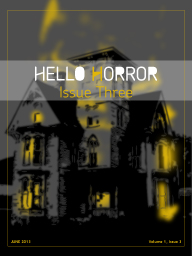
appears in the June 2013 issue of HelloHorror.
The authors published at HelloHorror retain all rights to their work. For permission to quote from a particular piece, or to reprint, contact the editors who will forward the request. All content on the web site is protected under copyright law.